



Hi everyone!
Welcome back to Starting from Zero, the series where I sit down with writers who began exactly where you might be right now: no audience, no plan, no proof that any of it would work.
Lidiya is a fascinating one for this series, because in one sense she’s the opposite of a beginner. She’s been blogging since 2013, built a whole business around brand partnerships, and teaches bloggers how to earn from sponsorships.
And yet, when she came to Substack, she chose to start at absolute zero, she didn’t bring her existing email list over. She began this the way the rest of us did: from nothing.
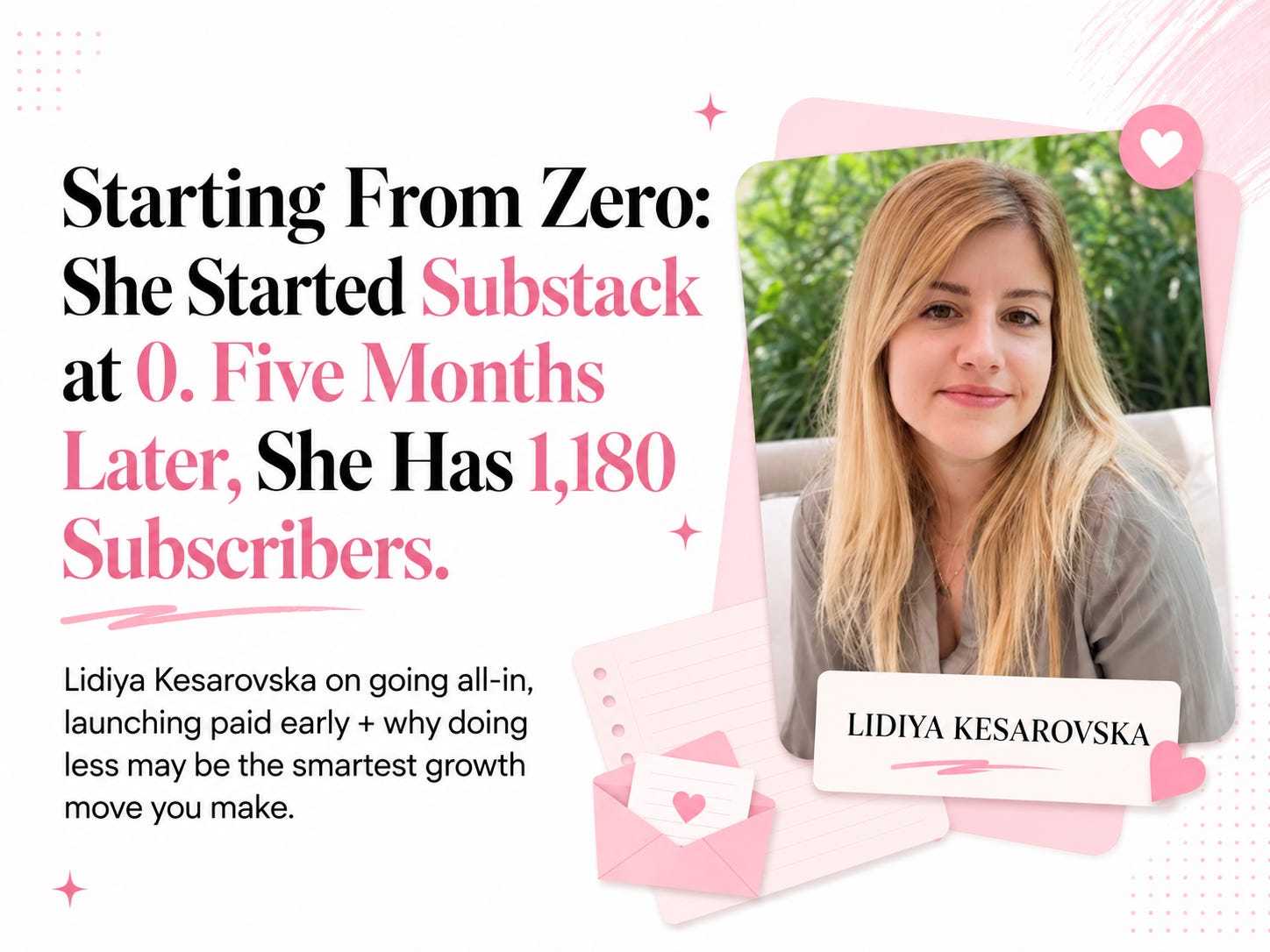
What happened next is worth sitting with. She started actively creating here at the end of March, and she’s documented every month of it out loud.
Her own growth updates show page views climbing from 1,900 in May to 3,509 in June to over 10,000 in July. And she’s now at 1,180 free subscribers and 17 paid, with 75+ articles published, all in about five months. As a new mom, no less.
But the thing I most want you to notice is her philosophy, because it’s right there in her publication’s name: The 2-Hour Blogger.
She’s built a business designed to fit her life instead of consuming it, and her one-word advice for beginners ‘simplify’ is the very same idea.
I’ve kept her answers in her own words and only lightly tightened them. Pull up a chair.
I didn’t want to build a business that consumed my life, About — The 2-Hour Blogger
1. What finally made you hit publish, after wanting to for so long?
Thanks for having me, Yuvika! This is honestly one of my favorite topics to write about, hehe.
All roads this year led me to Substack. My blogging business was getting quieter, and I knew I needed another place to put all the content ideas in my head, but one that would actually reward me.
I’d tried social media the year before, even though I knew it wasn’t for me, and it only drained me. It wasn’t where I belonged.
I’ve been in the online content space for a decade, and I always study the trends. I could see the ground shifting: AI changed how people search, Google’s algorithm stopped favoring website owners, personal brand mattered more than ever, and authenticity was winning in the long run, which is what I’m all about.
People were tired of generic advice and AI-generated content. They wanted intimate spaces where real conversations happen, and like-minded people around them. And my favorite trend of all, long-form content is back, which is my specialty.
Then I watched my mentors and a lot of big creators move their audiences here, with Gary Vee practically screaming from the screen that Substack is THE place to be if you’re a writer.
So I checked it out, first as a reader, and quickly felt the massive potential. I already had topics and a decade of blogging skills to bring over, so my learning curve was small.
But I remember the other side of this too.
Back when I started my blog, I had all the hesitation, the fear, the not-knowing. I waited a long time. Eventually, the message I wanted to share won out; I figured it out, and I published.
So I know that beginning stage well. It’s a beautiful one, you just have to go through it and build consistency, no matter what the numbers say.
2. What did you believe about growing on Substack that turned out to be wrong?
I came in with no expectations, which I think helped.
I did assume I’d create for Substack in addition to my blog and main email list — which, by the way, I never brought over. I started from zero subscribers here.
But I quickly realized Substack had everything I’d ever wanted in a platform, and it became my main content hub.
A month or two later I left almost everything else behind, and soon after, I went all in. Every one of my business activities became a Substack activity. A big risk, but one I had to take.
3. How did you land on your topic, and how sure were you at the start?
I was already teaching blogging as a business with a focus on monetizing through brand partnerships and writing a lot about online business and the mindset behind it. So I had plenty to say.
But a few weeks in, I realized a lot of that wasn’t quite relevant here, and that what I was truly passionate about was growing on Substack itself, applying my existing skills to it.
People started asking about that, so I leaned in. There’s a big overlap with what I wrote before, but I had to learn exactly how Substack works: SEO, content and monetization, newsletter growth and email marketing, branding, and Substack growth itself.
Brand partnerships too, though those work a bit differently here, something I plan to explore and write about soon.
This is a lovely full-circle detail! Lidiya runs her own interview series on The 2-Hour Blogger, featuring Substack creators from 2K to 34K subscribers. So for once, it was a treat to turn the questions around on her.
4. What’s actually driving your growth right now?
I started actively creating here at the end of March, so it’s five months now, and I’m at 1,180 free subscribers and 17 paid.
Mindset plays a huge role. I only compare myself to others when it empowers me. I see someone growing and take it as proof it’s possible for me too. Most of my subscribers come from Notes, some from articles.
I’ve published 75+ articles since I arrived, so if you do the math, I’ve been busy. I showed up daily for months: posting Notes, studying bigger creators, engaging genuinely, and leading with value in everything I make.
She’s unusually transparent about this.
Every month she publishes a Substack Growth Update with her exact numbers, screenshots, what worked and what didn’t, the kind of receipts most creators keep private. Her July update is a good place to see how she actually thinks about growth.
If you’d like to study your own Notes without manually digging through every one, this is the little tool I built for that. It shows you what brought subscribers, the patterns behind your strongest Notes and what may be worth doing more of.
5. How do you keep showing up when the numbers are small?
I’m used to small numbers from growing a blog, starting niche sites, building an email list, being a nobody on social media, and testing things for years that never paid off. I’ve felt all the negative emotions around that. But I don’t let it distract me anymore.
My time is limited now that I’m a mom, and honestly that helps. It forces me to prioritize ruthlessly, stick to my big vision, and only work on what feels aligned. There’s no way to avoid small numbers when you’re starting out.
What fascinated me was watching my mentors and self-made millionaires I’ve learned from for years join this platform and start from scratch too. They had to learn how Substack works, and even the ones who brought part of their audience were stepping into something new, probably feeling some discomfort of their own.
6. What tools or AI do you actually use each week, and what’s hype?
I use ChatGPT for brainstorming ideas, article outlines, titles, SEO descriptions, and product ideas. Canva for visuals and for the PDF of the Substack Growth Audit I offer.
Podia to sell digital products (I had that before Substack). For my blogging business, I use WordPress and Flodesk for email marketing.
7. Should beginners think about money early, or wait?
Both can go really well, and either can disappoint you.
What matters is the intention behind monetizing.
Are you turning on paid because everyone else is, or because a coach told you to or are you genuinely open to seeing how it goes and confident you can deliver enough value in return?
Only you know that.
Substack is unique here: people can pay simply to support your work, without necessarily expecting exclusive content.
So if you’re not overthinking it and you just want to turn the paid tier on and keep writing happily, great, do that, and maybe add bonuses for paid members later.
But the reality for most beginners is different.
They feel pressure to turn paid on, don’t have a clear promise for what the tiers offer, carry limiting beliefs around sales, and may not have the capacity to deliver what they promised.
That can actually slow your growth, because it makes you question your self-worth, wait anxiously for paid subscribers, feel like a failure without them, and get overwhelmed creating for two tiers. In that case, it’s probably not time yet.
The right time tends to come when you have a solid niche and core themes, good positioning, great reader feedback, the right kind of subscribers, and something more to offer those ready to invest in you.
For some people, digital products or coaching work better than paid subscriptions, which changes the model entirely.
I turned my paid tier on with a few hundred subscribers, and I already had paywalled posts, because I had exclusive content to bring over from a blogging membership I’d run for a year.
I even wrote about why I’m glad I launched it early. Monetizing early teaches you a lot. It shows you your gaps and whether you’re really ready. It’s the best test there is.
Four months in, I released my first real offer: a personalized Substack Growth Audit, with recommendations and an action plan. It’s a standalone offer and a bonus on my annual tier, and it’s actually why a couple of people became yearly subscribers.
It’s where I do my deepest work.
I’ve done eight so far, and now that I know how much time each takes, I’m restructuring, creating a Founding tier and moving the 1:1 audit there, while monthly and annual members get the closest self-guided version. That’s the direction I’m heading.
8. What growth advice do you now ignore?
I never did the sub-for-sub thing. It doesn’t build a quality email list.
We need to find the people we can actually help most, and that happens by publishing quality content, demonstrating expertise, and having real conversations on the topics we know best.
That’s what makes people associate you with those topics and it’s also what tells the algorithm what you’re about and who to send your way.
9. If you started over tomorrow, what’s the one thing you’d do differently?
I’m all about experimenting and learning, so there’s nothing I’d really change. I did set stricter boundaries recently to avoid burnout, though.
One was to use Substack mostly from my laptop for focused work, and not like a social media app on my phone.
I now let the Activity tab hit 100+ notifications without worrying, the comments will get answered, just not the instant they arrive. There’s other work to do. That’s something I could have started earlier. 🙂
10. What’s one tiny action a reader can take today?
Simplify.
Stop doing one thing that’s draining you, something that doesn’t move the needle, that others tell you to do but doesn’t feel right for you, or that’s simply too much.
Maybe it’s lives. Maybe it’s having a paid tier. Or maybe it’s posting on Notes too often. Maybe it’s a publication Chat (you don’t need one).
Lidiya’s advice to simplify is also the reason I built Quiet Notes Insights + Studio. I didn’t want to lose a whole weekend clicking through individual Notes just to understand what was working. Now the tool does that part for me, so I can spend the time writing instead.
Maybe it’s reading too many articles but not creating enough. Maybe it’s being on the app too much. Maybe it’s the product you think you have to make. Simplify. You can always add it back later, when you have the mental space.
It’s no accident that her single tiny action is the same as her whole philosophy. The 2-Hour Blogger isn’t just a name it’s a standard.
Build the calm, focused business that fits your life, and cut whatever doesn’t serve it.
Before you go
If there’s one thing Lidiya’s story proves, it’s that starting from zero isn’t only for the brand-new.
A decade of experience didn’t exempt her from the slow, quiet beginning, she chose it, walked through it, and built something real on the other side, one simplified, aligned step at a time.
If this resonated with you, go say hello to Lidiya.
If you’re a blogger or writer who wants a calmer, more profitable writing business, without the burnout check out her newsletter The 2-Hour Blogger. She shares the real numbers, the real strategy, and the behind-the-scenes of building it all in public.
I’d love to know which of her ideas resonated with you! Let me know in the comments section below. I read every single one, and I’ll reply. 🤍
If you’d like to study your own Notes without manually digging through every one, this is the little tool I built for that. It shows you what brought subscribers, the patterns behind your strongest Notes and what may be worth doing more of.
Want to keep reading? Try this:
How to Get Your First 200 Substack Subscribers (50 Days, No Audience, No Hustle)

Confession before we begin. It was Enola Holmes night last sunday in our house!
Thank you so much for the feature, Yuvika!
It was fun answering the questions 🥰
What a great interview with @Lidiya Kesarovska! I enjoyed reading it. 😊